
On 11th September 1609, British explorer Henry Hudson, under patronage of the Dutch East India Company, set off the Atlantic coast of North America on board of the Halve Maen (half moon) to explore a promising estuary, thinking it might lead to the much desired Northwest Passage to India. Crossing The Narrows, he soon reached the southern tip of an island that was called to become the center of the world. It was called Mannahatta, "land of many hills", by the Lenape people who lived there.
Now, 400 years later, we have the opportunity to see this island through the eyes of Henry Hudson. The Mannahatta Project makes it possible.
Showing posts with label history. Show all posts
Showing posts with label history. Show all posts
Saturday, 12 September 2009
Mannahatta

Monday, 15 June 2009
Great Plains
I have seen a world of ice covering the land, whose incomparable beauty on the reflections of the delta Sun would have brought tears to the eyes of any mortal.
I have seen the ice melting, leaving space for a vast primeval ocean in whose womb everything began.
I have seen the thunderous clash of continents, I have seen land masses emerging, I have seen green organisms conquering them.
I have seen the rising of mighty rocky mountains to the West.
I have seen a very bright explosion to the Southeast that brought cold, famine and death.
I have seen a shallow sea leave place to a sea of grass, its vast ranges pastured by gigantic bison herds, further than the eye can see, reaching beyond the limits of my extensive dominions.
I have seen Red People living in balance with the Nature, feeding on bison but revering them at the same time.
I have seen the Great Stream to the East.
I have seen the first White People come from the South, moved by their greed in search of the descendants of the seven bishops of Mérida, in search of the mythical cities of Cíbola and Quivira. I have seen them fail.
I have seen the second wave of White People come from the East, at first on poorly constructed wagons, later riding smoky iron steeds, restless marching on shiny paths.
I have seen White People hunting millions of bison to sell their skins and bones and leave everything else to rot away. I have seen the bison being driven to near extinction by pure greed.
I have seen White People forcing Red People to move away, into the West or into reservations.
I have seen millions of settlements under the Homestead Act, I have seen the land divided in great numbers of 500 acre farms, poor White People trying to make a living out of them.
I have seen technological achievements cause deep open wounds to the land. I have seen ploughs that had the power to wipe out the soil, the same soil that kept moisture even in dry periods.
I have seen people mistakenly thinking that the climate of the region had changed, that rain really followed the plough. I have seen the land being converted into a massive granary for the contenders of a distant world-scale war. I have seen mechanization. I have seen the land being squeezed to the last of its riches.
I have seen the return of drought. I have seen the uppermost layers of the land literally being blown away in my arms. I traveled on dust storms, I brought the soil thousands of miles away, I deposited much of it on the bottom of the ocean. I created black blizzards on half a continent.
I have seen millions of people having to leave their homes buried under the dust. I have seen them load all their possessions in poor trucks and set out for the West, where oranges grow and honey flows... at least that is what they thought. I have seen misery, hunger and starvation.
I have seen thousands of ghost towns.
I have seen strange circles sucking water much faster than it can possibly be recovered.
I have seen slender white towers growing on the land. I am going to gracefully give them a little amount of my endless energy.
(all images taken from Wikimedia Commons)


Thursday, 12 February 2009
Little Things (i)
A week ago, our computer started showing signs of sickness: blue screens of death, random behaviour, etc. After trying recovering her the whole week, reinstall the operating system, seeing that it would not help, despairing a little bit, giving it another try, and again and again, we realised it was a defect on one of the RAM modules. We replaced it by a new one and here we are again, after a week without computer.
After all the pain, I was thinking about what a strange thing it is how something so small (certainly not bigger than a thumb's nail!) may have such a big impact in our daily life (because, who are we kidding?, we are nothing without a computer and internet).
I have always felt fascinated by things that, even apparently small and meaningless, have the potential of changing our lives, even forever, or directing the evolution of our society to unexpected places.
In the autumn of 1872, some horses in Ontario, Canada, started showing signs of illness: they could not stand up, violently coughed and had no strength to pull any kind of load. It was the beginning of the 1872 American outbreak of equine influenza, which would spread quickly across the whole East half of North America. Same year's Great Boston Fire was so devastating because all fire department horses were sick and could not move.
This epizootic was one of the major causes of the so-called Panic of 1873, which in turn marked the beginning of the Long Depression, that would last until 1879. The influenza affecting virtually every single horse, economy ground to a halt in a way difficult to imagine: railways came to a halt because no coal could be delivered to locomotives. Men were forced to pull wagons by hand, tramways stopped and basic supplies could not be delivered to the cities.
Some years before, in 1863, one of the ships crossing the Atlantic Ocean brought an unexpected stowaway on its trip back to Europe. So started the spread of Phylloxera throughout the Old World, destroying all Vitis vinifera vineyards after them. In 1877 the plague crossed the Pyrenees and reached for the first time Catalan grapevine crops.
Catalan grape growers had the so-called rabassa morta contracts, by which a farmer had the right to the ground as long as the vines were alive. The European grapevines lasting for about 70 years, a farmer could work on the same field for life. In order to fight the plague, the breeding of Vitis vinifera with resistant native American species was needed, because the latter are naturally Phylloxera resistant. These new species, though, were much more short-lived, around 20 years, what left many young vine growers without fields to work on. Landowners would extend the agreements quite arbitrarily.
Catalan rabassaires suffered a great dissatisfaction and, organised in unions like Unió de Rabassaires, were one of the many factors contributing to the electoral triumph of the Spanish Popular Front (Frente Popular) in 1936. Unfortunately, we all know what came afterwards...
Even though we may see the equine influenza virus or Phylloxera as the villains in these stories, as the ones directly causing that much suffering, I think that the cause of human tragedies lies often in humans themselves, in archaic social structures, in our greed and meanness.
(to be continued...)


Monday, 28 January 2008
Lost & found
3500 negatives from Robert Capa's series of photographs on the Spanish Civil War have been found in Mexico. After being considered as lost for 70 years, the circle has been closed, and we might end knowing something more about some of his most famous pictures.
Robert Capa, born in Budapest in 1913 as Endre Ernő Friedmann, was one of the greatest photographers in the 20th century. His most famous picture might well be "Spanish Loyalist", taken near Cerro Muriano, in Córdoba, depicting the death of a Loyalist Militiaman after being shot by Fascist machine-gun fire.
The proximity to the subject, the perfect exposure and timing, the angle... rose doubts about the authenticity of the picture. Some said Capa staged the death of the Loyalist. Until 1995, when a certain Mario Brotóns Jordà published his memoirs on the Spanish Civil War. Brotóns, himself a veteran of the Córdoba front, recognised the leather bullet pouches in Capa's photograph that were made in that fashion only in Alcoy, and that only the militiamen from Alcoy carried. Based on other indications on Capa's photograph, it could be dated to 5 September, and Brotóns found in the archives that the only militiaman from Alcoy who was killed on 5 September 1936 on the Córdoba front was Federico Borrell García. Brotóns traced a surviving brother of the deceased soldier and showed him the photograph. The brother was able to recognise Federico on the picture. Capa's "Loyalist" really did fall in battle.
Who knows what will these lost and found negatives tell us about the circumstances, about the people, about the dreams, about the nightmares of a whole generation. Capa said once "If your pictures are no good, you didn't get close enough", meaning by that not only the physical but also the emotional proximity with the subjects required to produce a really great photograph.
But there is yet another quote from Robert Capa that I really love. He said once, in an interview with the World Telegram: "No tricks are necessary to take pictures in Spain. You don't have to pose your camera. The pictures are there, and you just take them."

Saturday, 19 January 2008
Sounds of destruction
Every Saturday, exactly at 12:00 a.m., the city alarms of Salzburg (and, apparently, those of every city and town in Austria) are tested for half a minute. Their sound, loud and continuous, always remembers me of air raid alarms. It might well be that they are the old WWII bomb alarms, reused as city sirens...
Salzburg survived the end of World War II relatively well. Its geographical situation, deep into the then-German Reich, kept it out of the reach of Allied bombers well until the death of Mussolini. But its relative strategic unimportance, when compared to more industrial cities like Hallein, Linz or Graz, let it remain mostly ignored even when the Allies where already in Italy.
The bombing raids over Salzburg (with a total of 15) started on October 1944. People would have to run into the city hills, Kapuzinerberg and Festungsberg, into the underground shelters. The Hexenturm (Witches' Tower), part of the old military defenses, not far away of present-day Schrannenmarkt, was literally wiped out. One of the city's water reservoirs, up on the Mönchsberg, was destroyed as well, adding flood to the existing chaos. A bomb even entered the Baroque cathedral, perforating the dome, but it did not explode. Some say Virgin Mary made a miracle...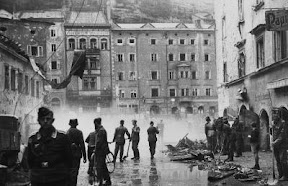
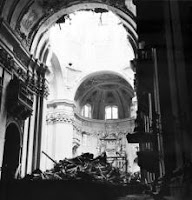
I learned about the air raids over Salzburg in a book that I catched some time ago, an autobiography of playwright Thomas Bernhard, who happened to spend his childhood in Salzburg during WWII.
Fortunately, I have never found myself in a bombing raid, and I do not know how would I act. I think fear would completely paralyse me, but I hope I never know. What I do know is that the only thing that is left is destruction, stillness, emptiness. But we humans do not seem to learn the lesson.
The famous view from the Dresden City Hall Tower comes to my mind. Or the ghostly quietness of the Old Town of Belchite, destroyed by Francoist troops during the Spanish Civil War and kept untouched as a tribute and as a warning.
I hope I'll never know how it feels to walk through the streets of your home town after being destroyed. But I guess it may feel like walking through a forest after a fire. That is an image I for sure will never forget. It was in Vespella, near Tarragona. I had ridden my bicycle to the top of a hill, and at the other side there was nothing but desolated moon landscape for as long as my eyes could reach. Tortured black tree corpses everywhere. Ashes. The smell. The unnatural stillness. Destruction. Absolute emptiness.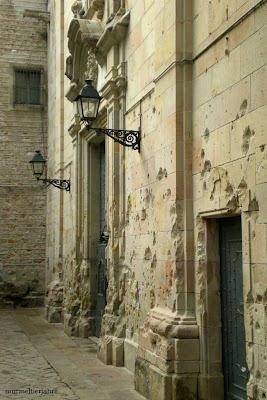

Subscribe to:
Posts (Atom)
 versión en español


