Showing posts with label nature. Show all posts

Sunday, 26 September 2010

Musical rides

This week I did something that I had never done before: I was able to ride my bicycle to and from the office for 5 days in a row, Monday to Friday. Not only do we seldom enjoy such a fine weather for such a long time, it is also very rare for me to get over my weaker self and not to fall victim to any of the numerous excuses at my disposal. I am really proud, I must say.

My ride to the office runs along the Salzach river. For most of the trip I use the bike path, which is a reconverted tow-path, used hundreds of years ago by horses and oxen for towing upstream the boats that, after reaching the salt-mines in Hallein, would be loaded with salt and driven downstream again, to give Salzburg its name (“salt castle”) and to make its prince archbishops awfully rich.

The ride is some 17km long (one-way) and I spend a little less than an hour on it —I am not at all fast! The first two days, especially Tuesday, were quite hard because I got headwind and I was still tired after a hike on Sunday. I got a little obsessed with the cycle computer as well, trying not to do too bad for the statistics. But from Wednesday on, I tried to ignore the computer and simply enjoy the ride.

I realized that there is a kind of physical “in-the-zone” feeling, a delicate and wonderful equilibrium between the force you exert on the pedals and the resistance from wind, road and gravity (slope). That means, there is always a minimum amount of force you have to use in order to maintain a certain pace. The trick is to use just this minimum force, but not more. If you try to keep the pace uninterrupted, by switching gears accordingly, you may be able to run and run with minimal effort and without even realizing the distance.

Bicycle Ride

The funny part is that this kind of being “in-the-zone” happens in your mind as well. At least, once I've achieved this equilibrium of forces, my mind seems to become hypnotized by the rhythmic movement and I stop thinking about riding at all and my awareness wanders to other places.

And in this state, invariably, music comes to my mind. I guess it's because the pedalling pace is kind of a metronome that you cannot miss. It's not that I think: Let's sing “Mary had a little lamb”! Songs and melodies simply pop up in my mind. They come and go, without warning, at times switching from one to the other in colourfully wild arrangements that I would certainly not be able to make myself.

This is a selection of some of the melodies that came into my mind during this week's bicycle rides. Interestingly enough, Johann Sebastian Bach seems to have got a stronghold in my brain:

  • Prelude from Cello Suite No. 1, BWV 1007, by J. S. Bach

  • Variation 1 a 1 Clav., Goldberg Variations BWV 988, by J. S. Bach

  • Sinfonia No. 2, BWV 788, by J. S. Bach (listen here)

  • Gabriel's Oboe, “The Mission” original soundtrack, by E. Morricone

  • Another composition for two violins by J. S. Bach (I think!) which I can sing but I still haven't found out what it is 2nd movement (Largo) from the Concerto for 2 Violins, Strings and Continuo in D Minor, BWV 1043, by J. S. Bach (listen here)


But, without a doubt, this week's winner has been the Prelude from J. S. Bach's Lute Suite No. 4, BWV 1006. Enjoy!

Friday, 11 June 2010

Longing for water


Time-lapse tomato plants.

Tuesday, 2 February 2010

Groundhog Day

Today is Groundhog Day.

As an interested party, we from this blog celebrate this beautiful tradition, imported to North America from Central Europe, where it does not exist any more, and we are curious about what do Phil and the others predict for this year: are we going to have an early spring or do we still have to go through six more weeks of winter?

Tuesday, 1 September 2009

Letting time go by...

The end of summer is near.

The sun that used to enter relentlessly through my office window each afternoon, hides behind the fir trees on top of the mountain faster and faster. A sun that, incidentally, I prefer to face with an open window that, at least, lets some breeze go through, than to follow one of these unfathomable Austrian schools of thought that advocate for closing windows in order to keep the air inside cool. In my opinion, a more than debatable idea that, at most, would be valid in combination with a blind or something opaque for that matter. But this is an invention that still has not made it to my office, unfortunately.

The end of the summer, as I was saying, is near. Summer is the season whose ending I am most excited about. First of all, because summer ending marks the beginning of autumn and this one is truly my favourite season. Secondly, there are many minus points that go away with the summer: it stops being too hot, garbage stops stinking, you are able to sleep at night and people, you know, stop smelling (so) bad... And last, but not least, summer sun is way too intense and its rays fall way too vertical, just to shed light over a uniformly dull green colour that does not allow many fun with photography.

Castanyers

Because, I have to admit it, even if it means being despised by my neighbours, I don't like summer. In fact, summer is the last in my list of favourite seasons: first comes autumn, in quite challenged second and third places winter and spring, and way way back, summer.

Anyway, a good thing about summer are those lazy Sunday afternoons, with nothing more to do than taking a sandwich and your bike, ride half an hour to Hellbrunn, lay down on the grass and let time go by, reading a book, sleeping, eating your sandwich, playing around with nice puppies that come over and, in sum, enjoying today's favourite word: Müßiggang, meaning idleness, otiosity.

Muessiggang

Let this Müßiggang ride along with us on our way back home...

Saturday, 15 August 2009

Am I late?

You know I have a thing about dandelions. I find these plants fascinating in many senses, although this does not really seem to be a popular opinion among lawn-owners.

One of the fascinating facts about dandelions is the way they reproduce. Many dandelion species do it by apomixis, which means they do not reproduce sexually, which means there are no two individual "parents" that produce offspring, but a single individual that produces exact genetic copies of itself.

This kind of reproduction, based on an exact duplication of genetic material, is not very different from the cellular division that happens in our bodies all the time, say when our hair or nails grow or when new red blood cells are created in our bone marrow. In a sense, dandelions or other species that reproduce asexually, challenge our conception of what an organism is.

In his book The Extended Phenotype Richard Dawkins makes a mind-blowing point about dandelions and organisms (emphasis is mine):

"Janzen (1977) faces up to the same difficulty, suggesting that a clone of dandelions should be regarded as one 'evolutionary individual' [...], equivalent to a single tree although spread out along the ground rather than raised up in the air on a trunk, and although divided up into separate physical 'plants' [...]. According to this view, there may be as few as four individual dandelions competing with each other for the territory of the whole of North America. [...]"
Dawkins, R.: The Extended Phenotype, Oxford University Press, New York, 1982, p.254

It is mid-August now and the peak of dandelion flowering season is long gone. Long gone? If you pay attention, you still might see some late-comers, those poor lazy ones that are always too late.

Am I late?

And if you come down close enough, you almost can hear them asking themselves: What is going on here??? Where is everybody???

Monday, 15 June 2009

Great Plains

I have seen a world of ice covering the land, whose incomparable beauty on the reflections of the delta Sun would have brought tears to the eyes of any mortal.

I have seen the ice melting, leaving space for a vast primeval ocean in whose womb everything began.

I have seen the thunderous clash of continents, I have seen land masses emerging, I have seen green organisms conquering them.

I have seen the rising of mighty rocky mountains to the West.

I have seen a very bright explosion to the Southeast that brought cold, famine and death.

I have seen a shallow sea leave place to a sea of grass, its vast ranges pastured by gigantic bison herds, further than the eye can see, reaching beyond the limits of my extensive dominions.

I have seen Red People living in balance with the Nature, feeding on bison but revering them at the same time.

I have seen the Great Stream to the East.

I have seen the first White People come from the South, moved by their greed in search of the descendants of the seven bishops of Mérida, in search of the mythical cities of Cíbola and Quivira. I have seen them fail.

I have seen the second wave of White People come from the East, at first on poorly constructed wagons, later riding smoky iron steeds, restless marching on shiny paths.

I have seen White People hunting millions of bison to sell their skins and bones and leave everything else to rot away. I have seen the bison being driven to near extinction by pure greed.


I have seen White People forcing Red People to move away, into the West or into reservations.

I have seen millions of settlements under the Homestead Act, I have seen the land divided in great numbers of 500 acre farms, poor White People trying to make a living out of them.

I have seen technological achievements cause deep open wounds to the land. I have seen ploughs that had the power to wipe out the soil, the same soil that kept moisture even in dry periods.

I have seen people mistakenly thinking that the climate of the region had changed, that rain really followed the plough. I have seen the land being converted into a massive granary for the contenders of a distant world-scale war. I have seen mechanization. I have seen the land being squeezed to the last of its riches.

I have seen the return of drought. I have seen the uppermost layers of the land literally being blown away in my arms. I traveled on dust storms, I brought the soil thousands of miles away, I deposited much of it on the bottom of the ocean. I created black blizzards on half a continent.


I have seen millions of people having to leave their homes buried under the dust. I have seen them load all their possessions in poor trucks and set out for the West, where oranges grow and honey flows... at least that is what they thought. I have seen misery, hunger and starvation.

I have seen thousands of ghost towns.

I have seen strange circles sucking water much faster than it can possibly be recovered.


I have seen slender white towers growing on the land. I am going to gracefully give them a little amount of my endless energy.


(all images taken from Wikimedia Commons)

Monday, 4 May 2009

Elder revisited

You'll probably remember my story about a parasitic elder growing on top of a maple tree.

Well, now the "maple" has finally grown its own leaves and I discovered that it is not a maple tree at all! It has pinnate leaves, instead of the well known maple tree leaves. Its trunk does not quit look like the other maple trees either and the branches have thorns.
Robinia pseudoacacia

Those leaves remembered me of some acacia that grew in my birthplace as I was a child. I liked the oval form of its leaflets very much. After some internet research, I came across what I think is the real identity of my mystery host tree: it is no acacia, but a black locust (Robinia pseudoacacia), also known as false acacia, because it bears a striking similarity to them.

Now I'm not so sure that the elder slowed down the false acacia in growing leaves. Maybe it's just that maple trees are much faster than false acacias. But I discovered some (not parasitised!) false acacias quite close. They have all their leaves, too, but I don't know when did they grew them.

I'm going to have to continue my field research next year!

Monday, 27 April 2009

Dandelion


They see Unkraut (bad weeds)...

... I see the peerless beauty of evolutionary success.

Dandelion

Monday, 20 April 2009

Strange Nature

Sometimes Nature surprises us with scenarios seemingly taken from a horror film, for instance this tree, which is taking revenge on those who hammered a traffic sign into it, slowly but without a rest...

Revenge

I happen to meet another such scenario, not as horrific but still quite surprising, in my way by the river from the office to the bus stop. At the side there are some maple trees. Last year I realised that one of them has an elder on top of it, don't really know how. I was able to spot it because elderflowers are quite easy to recognise, because of the looks and the smell. "Strange", I thought, "how did this fellow manage to grow up there?"

Elder on maple tree 02

These last weeks I am observing the maple with an elder, and I've seen something interesting. All other maple trees at the pathway already have lots of leaves, green and well formed. But the one with the elder on top has just started putting out little shoots, while the elder not only has all of its leaves fully formed, but also has sprouted the first elderflowers.

Elder on maple tree 01 Maple tree without elder
The maple with an elder (left) and a "normal" one (right). The latter has already lots of leaves, but on the former the only one with leaves on it is the elder!

That means, then, that the elder is, undoubtedly, a parasite of the maple tree. You'll never be too old to stop getting surprised...

Saturday, 4 April 2009

Conservationism

Lately I have found myself thinking and reading about life on our planet, about its first babbles, its current state and its future.

My awareness for conservationism has been shaped by readings and curiosity about the environment since my teenager years. But I think the true roots of this awareness, my realising the role we humans play about Nature, lay way back in the past, in my childhood, with two songs written by Joan Manuel Serrat, a Spanish Catalan singer that is part of the subconscious psyche of almost all members of my generation, thanks to our parents and the miracle of gramophone and compact cassette.


Pare
digueu-me què
li han fet al riu
que ja no canta.
Rellisca com un barb
mort sota un pam
d'escuma blanca.

Pare
que el riu ja no és el riu.
Pare
abans que torni l'estiu
amagui tot el què és viu.

Pare
digueu-me què
li han fet al bosc
que no hi ha arbres.
A l'hivern
no tindrem foc,
ni a l'estiu lloc
on aturar-nos.

Pare
que el bosc ja no és el bosc.
Pare
abans de que es faci fosc
tanquem la vida al rebost.

Sense llenya i sense peixos,
pare,
ens caldrà cremar la barca,
llaurar el blat entre les runes,
pare,
i tancar amb tres panys la casa,
Ai, dèieu vostè...

Pare
si no hi ha pins
no es fan pinyons
ni cucs ni ocells.
Pare
si no hi ha flors
no es fan abelles,
cera ni mel.

Pare
que el camp ja no és el camp.
Pare
del cel avui ens plou sang.
El vent ho canta plorant.

Pare
ja són aquí!
Monstres de carn
amb cucs de ferro.
Pare
no, no tingueu por,
digueu que no,
que jo us espero.

Pare
que estan matant la terra.
Pare
deixeu de plorar
que ens han declarat
la guerra.

Father,
please tell me what
have they done to the river
that it doesn't sing anymore?
It runs like a barbel
dead under a handspan
of white lather.

Father,
the river is not the river anymore.
Father,
before Summer comes again
hide all that's alive.

Father,
please tell me what
have they done to the woods
that there are no trees?
In winter
we won't have fire,
and in summer no place
for us to rest.

Father,
the woods are not the woods anymore.
Father,
before it gets dark
let us store life in the larder.

Without firewood and without fish,
father,
we'll have to burn the boat,
grow wheat among the rubble,
father,
and use three locks for the house,
Oh, would you have said...

Father,
if there's no pine trees
there'll be no nuts
no worms, no birds.
Father,
if there's no flower
there'll be no bees,
no wax and no honey.

Father,
the fields are not the fields anymore.
Father,
it rains blood from the sky today.
The wind sings about it crying.

Father,
they are here!
Flesh monsters
with their iron worms.
Father,
no, don't be afraid,
and say no,
I'm waiting for you.

Father,
they're killing the earth.
Father,
please stop crying
because they've declared
war on us.


This sond, as I was saying, resides so deeply in my subconscious, so stuck in my soul, that big tears run down my cheeks every time I listen to it. The same happens with the next song, Plany al mar (Lament to the sea).


Bressol de vida,
camins de somnis,
pont de cultures,
ai!, qui ho diria,
que ha estat el mar?

Mireu-lo fet una claveguera,
mireu-lo anar i venir
sense parar.

Sembla mentida
que en el seu ventre
es fés la vida.
Ai!, qui ho diria
sense rubor?

Mireu-lo fet una claveguera
ferit de mort.

De la manera
que el desvalissen
i l'enverinen,
ai!, qui ho diria
que ens dóna el pa?

Mireu-lo fet una claveguera,
mireu-lo anar i venir
sense parar.

On són els savis
i els poderosos
que s'anomenen
ai!, qui ho diria,
conservadors?

Mireu-lo fet una claveguera
ferit de mort.

Quanta abundància,
quanta bellesa,
quanta energia,
ai!, qui ho diria?,
feta malbé.
Per ignorància,
per imprudència,
per incosciència
i per mala llet.

Jo que volia
que m'enterressin
entre la platja,
ai!, qui ho diria?,
i el firmament.

I serem nosaltres,
ai!, qui ho diria?
els qui t'enterrem.


Cradle of life,
paths of dreams,
bridge of cultures.
Who would have thought it?
That has been the sea.

Look at it looking like a sewer.
Look at it coming and going
without stop.

It's hard to believe
that in its womb
life was created.
Who could now say that
without a blush?

Look at it looking like a sewer,
fatally wounded.

Looking at the way
that it is stripped bare
and poisoned,
who could believe
it gives us our bread?

Look at it looking like a sewer.
Look at it coming and going
without stop.

Where are the wise
and the mighty ones
that they call themselves,
who would have thought,
conservatives?

Look at it looking like a sewer,
fatally wounded.

So much abundance,
so much beauty
so much energy,
who would have thought?,
totally ruined.
Out of ignorance,
out of imprudence,
out of irresponsibility
and out of meanness.

I wanted
to be buried
between the beach,
who would have though?,
and the firmament.

And it will be us,
who would have thought?,
the ones who'll have to bury you.

Sunday, 29 March 2009

Hoping for new life

I already told you about my struggle on growing Mediterranean tree species in Austria. Well, our orange trees are doing pretty well, but I am starting to loose my faith on the survival of the pine tree. I think it might have frozen as we were in Spain last Christmas.

I'm afraid the day will come when I'll have to accept the evidence and throw my little pine away. Knowing that I will be very sad about it, I decided to make up to myself for it by letting new life sprout before the day comes. Just in case.

It all started in the Paleoproterozoic, around 3000 million years ago, as the ice cap of the Makganyene glaciation (which might have covered the whole planet) retreated and left space for a vast ancestral ocean.

Two types of living organisms survived under the ice and rapidly populated this ocean. Archaea, which used several sources of energy such as sulphur or ammonia and produced methane as waste product, and a new kind of bacteria, the Cyanobacteria, able to obtain their energy through photosynthesis, a process that converts sunlight and carbon dioxide (CO2) into energy, releasing oxygen (O2) as a waste product.

Ur-Ocean

These cyanobacteria were so successful at reproducing and colonising the ocean that they actually changed the composition of the atmosphere and were going to shape the world for the next 3000 million years. Before cyanobacteria existed, there was not much oxygen in the atmosphere. Free oxygen in large amounts was in fact poisonous to most of the living creatures at the time, especially to archaea. Most life on Earth vanished in what is known as the Oxygen Catastrophe(*).

But serious stress factors like this great oxidizing event are notably the source of big evolutionary pushes: a whole new kind of bacterial organisms evolved, aerobic bacteria, which used oxygen (now available in huge amounts) as a source of energy, producing carbon dioxide as a waste product. And that's not all. By an outstanding touch of genius, some Archaea, facing a serious problem in this new and poisonous oxygen-rich environment, incorporated cyanobacteria or proteobacteria (a kind of aerobic bacteria) through the cellular membrane into their cellular bodies and used part of the energy produced by them to keep themselves alive. This brilliant trick, known as endosymbiosis, would be the origin of the eukaryotic cells, which contain several membrane-bound structures, each one specialising in a different function.

Those Archaea that associated with aerobic bacteria (which needed oxygen) were the basis for the fauna, to which we humans (**) belong as well. From Archaea that associated with cyanobacteria (which produced oxygen through photosynthesis) would originate the flora, that is, multi-celled living creatures able to obtain energy from sunlight through photosynthesis.

Tarongers(***)

I've been thinking about this long story, this long evolutive path, as I was sowing orange and lemon seeds to give plant life another chance. Now wake up!, you little seeds. Wake up from your long sleep, let sunshine and water put you in alert and consummate once again the miracle of life for me!

(*) This Oxygen Catastrophe in the Paleoproterozoic raised the atmospherical oxygen concentration to 4%. To reach the current level of 21% a colonisation of the land masses by plants and woods would be needed.

(**) Not all Archaea disappeared in the Paleoproterozoic. In fact, a great number of them are alive and well, living in the most incredible places. Big colonies of Methanobrevibacter smithii, for instance, live in the human gut and help us with digestion.

(***)
Taronger is the Catalan word for "orange tree".

Friday, 20 February 2009

It snows

I love it when it snows.

Because your usual pathways are disguised in white and you have to follow the footprints of others before you to walk along them.

Schneeweg

Because if you look at your coat close enough, you might see perfectly formed snow crystals, whose beauty will for sure captivate you.

SchneeFlocken

Because the quietness is almost supernatural. I can hardly imagine of anything more relaxing than looking at the snow falling through a window.


Because I cannot resist passing my hand over the freshly fallen snow.

Schneeaufräumen

I really love it when it snows.

Thursday, 6 November 2008

Favonius at work

Yesterday morning, as I went out home at 6:45AM, with a scarf around my neck, I was welcomed by an incredibly warm November morning. Even though the Sun had not still risen, we might have had 18ºC! How was that possible? Is it because now, with Obama, it won't be cold in November anymore? ;)

No. It is the Alpenföhn, a unique wind effect that happens near the Alps. When an air mass has to rise to spring over a mountain range, water condenses and falls as rain on the windward side. Past the maximum elevation, the dry air "falls down" the slopes and raises temperatures by as much as 30ºC on the leeward valley.


(Picture taken from Wikimedia Commons)

The name Föhn comes from the Roman God Favonius, who personified the west wind. Later on, it went through Rhaeto-Romance favuogn and fuogn until it reached modern German as Föhn. Interestingly enough, a hair dryer is called Fön, without "h". I read that the name was registered as trademark by AEG on the 20s.

The Föhn is often associated with migraines and psychoses. A study by the Ludwig Maximilian University in Munich claims that suicide and accidents increase by 10 percent during föhn winds in Central Europe. In fact, there is a Föhnkrankheit (Föhn sickness), which might be the perfect excuse to justify low performance on the job, excessive appetite or, simply, general apathy.

Other föhn wind examples around the world include the Chinook in the Rocky Mountains, North America, the Halny in the Carpathian Mountains, Eastern Europe, fogony and cierzo in the Pyrenees and viento del sur (southern wind) in Cantabria, northern Spain.

And I think I'm going to let it go for today, because, you know, there is Föhn today...

Friday, 24 October 2008

Days are getting shorter...

... November is almost here and I already rode my bike to the office for the last time this year ...

Untersberg

... the Sun strides through its journey in the sky lower and lower, long shadows and wonderful sunset light all day long ...

Festung

... and Cold and Darkness prepare themselves to rule over the Northern hemisphere for the next months. Strange organic sculptures wander around the city at night ...

DarknessCreature

Sunday, 29 June 2008

Hellbrunn's freeloader

This country is so perfectly beautiful that it doesn't seem real. But, if you pay attention, there are some spoungers as well:


Let's go see how the Spaniards do today. To the other side, to the neighbour country. No risk, no fun... ;)

Sunday, 1 June 2008

Waiting for the rain

The Mediterranean coastline is a hard piece of ground.

One of the first things that strucks the Mediterranean expatriate on arriving to Austria is the greenness, that incredibly saturated green colour, almost supernatural, whose brightness hurts those eyes that grew accustomed to red ochre ridges, yellow brooms, infinite blue sea and dusty green olive trees.

Soon after moving to Austria one realizes where does the green come from: flora has a rather easy life on this land because it rains often and abundantly. That's why trees can turn into 30 and 40 meter tall giants. That's why going into the woods outside paths is almost mission impossible in spring and summer, save you have a machete.

The Mediterranean coastline, I was saying, is a hard piece of ground. Because rain is there a really scarce good that, when it falls, does so in a short and wild way over a very dry ground that cannot soak it up and ends up causing floods instead of producing crops.

flors figuera de moro

But Mediterranean vegetation, as are its people, is old and wise and learned to wait, keeping all their energies for that couple raindrops that are going to fall, if not today, maybe tomorrow, or next week, or next month. And when those raindrops do eventually fall, they get strength out of nowhere, throwing roots to drink them, sprouting little shoots that will let them continue saving that light, that Sun, saving energy for the next drought.

brotes xiprers

I think Mediterranean vegetation is fascinating because of the way it holds on anxiously to life and carries on in spite of a rather hostile environment. I love it because it reminds me of its people, it reminds me of my people, who turned barren into cultivated land with sweat, blood, effort and resolution, under the remorseless Sun that burns everything out.

pins

Last week we have been to Catalonia. As we came back, my office colleagues asked me, as usual, if we'd had nice weather. And I told them yes, it'd rained every day and that's the best weather we could have wished for. I'm not sure that they really understood my smile and the joy I felt in my heart as I saw my land green and alive.

rambla

Monday, 12 May 2008

Follow your nose

One of the consequences of the enormous evolutive success of the human species has been the loss of contact with Nature. We live in stone boxes, some meters above the ground, days and days can go on without ever touching any soil with our hands, we drink bottled water and almost everything we eat comes on white trays in plastic wrap.

Some of our forefathers' abilities disappeared (as most surely our toes will do). Others are still there, but I do not believe they would be of any use now, had we have to survive and succeed in the hostile environment the first great apes lived in.

Yesterday I was thinking about that as I discovered, on a bicycle tour along the Danube river banks, some cereal ears. I'm pretty sure they are the same ears with which I played as a kid in school. We ripped them off with our pointing finger and thumb (I still can clearly remind the noise they made) to throw them to the other kids, because they would stick to the clothes, especially to wool pullovers. (*)

I was very aware of how the memory was built in my mind, first seeing the ears at the path sides, then picturing myself ripping them off, then touching them, then remembering the noise, and then the warmth of the memory...

Espigas

On the other hand, when it is a smell that reminds me of something, it comes to me almost immediately, as if the nose had direct line with the memory. Although they seem to be lost memories, they just need the right smell to be made appear sharply, with every little detail, as if I was living that again.

I always thought I have a good sense of smell. I suppose it is to made up for my short-sightedness and a certain increasingly hearing loss. I think smell is one of the most directly connected senses to our brain. Not to the most "conscious" part of it, but to that almost "reptilian" brain that controls our instincts. Because smell was already there before consciousness appeared, and memory was probably there, too.

I like bicycling to the office because, on this time of year, I am able to smell wild garlic even not being able to see it (did I mention my short-sightedness?). I like the different smells that fill up Salzburg's passages depending on the day of the week, depending on the time, depending on the passage. The passage going from Mozart's birthplace and Universitätsplatz smells of coal and sausages every Saturday noon. Close to Konditorei Schatz it always smells of cakes. Balkan Grill's passage always salutes our noses with the smell of a misterious spice blend and Nagano Restaurant's passage smells of soya sauce and seaweed.

I like the sense of smell, because it is proof of our past in the wilderness, as being able to distinguish a threatening smell from the smell of food could mean survival or death. Because it reminds us that we are nothing but little animals, somehow evolved, but still animals. I like it because my heart misses a beat when I smell the loved one behind me. I like it even though sometimes, when people use too much perfume, I almost can't breathe in the lift. I like the sense of smell because, sometimes, it brings about memories of my childhood, as we threw those cereal ears to each other, as we had not started chasing girls yet...

Patitos

(*) Mar says they called them the boyfriend plants, because the number of ears sticking to you was the number of boyfriends you had...

Sunday, 23 March 2008

The green thumb

I have a confession to make. For some years now I belong to a dormant cell of the ADL (Anti-Desertification League). Vegetation retreats, and more soon than late, the Sahara is going to be knocking on our doors. And we must fight.

There are many approaches to the problem. Some think the last hope of Southern and Eastern Spain are cork oaks. Most of the revenues from cork production come from wine corks. Ergo, if we want to stop the Sahara, let's drink lots of wine! But only if it uses real cork.

Another school of thought says that fighting from the rearguard is needed, by organising kind of summer camps for Mediterranean species in places with considerable rainfall. Some time ago I had a revelation as I was eating an orange and I joined this silent fight. We sowed some of the seeds and, to our surprise, four tiny little trees sprouted. Today, six years after, the orange trees are in the middle of that difficult teen age but they give us a little Mediterranean flair from the windowsill.

Plantetes02 Plantetes03

Our second guest has been a stone pine that came to Austria with us as a little pine nut, who was given the gift of life by the light of our fridge (well... I could say it was because of the cold stratification process, but who am I kidding?, we must clean more often!). After some childhood struggles, it seems to be doing all right, in spite of our faithless family.

Plantetes05 Plantetes04

As I was planting some daffodils that we adopted at the market, I spent all the morning organising activities for our little trees, like a good camp monitor. I will tell you about my Austrian camp's succulent section some other day...

Plantetes01

Some day, as we cannot refer to our little trees as "little" any more, we will bring them back to the front, because every help is more than welcome in this uneven fight.

Thursday, 18 October 2007

Autumn light

Sometimes I think about which is my favourite season: summer has some well accepted advantages, I love to hear my own footsteps on the snow in winter, and spring has the beauty of new born life. But if I had to choose, I would take autumn.

I tend to be a little melancholic from time to time, and when Nature shows its most grey face, I've always got a strange inner satisfaction about feeling that way, because it's easier to feel melancholy in cold rainy November than in bright sunny May. That would be a personal, attitude-related reason why I would choose autumn.

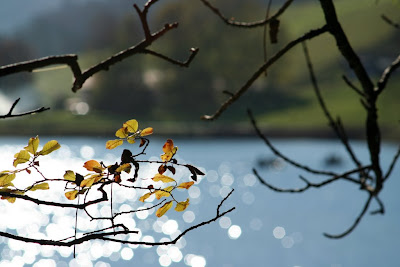
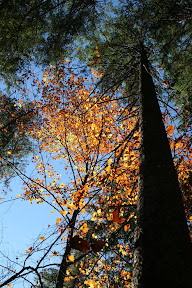
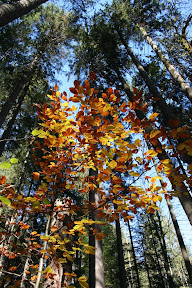
But there is another reason, in fact two. First, trees dress the most amazing colours in autumn. I could literally spend hours looking at the forest visual symphony being played every year. Second, this incredible colours have the most beautiful spotlight ever: a still bright sunlight falling down in a low angle. And its combination, dear readers, is a dream for the hobby photographer.


It is said that the best times of day for photography are sunrise and sunset. And there is a reason: When the Sun is very high in the sky, the sunlight traverses just a thin layer of atmosphere before reaching us, and it is too intense, it makes ugly hard shadows and effectively burns up our subjects. On the other side, when the Sun is lower, sunlight has to traverse a longer chunk of our atmosphere, and acquires a wonderful warm red tone along this journey. That happens after sunrise and before sunset.


The problem with sunrise and sunset is that the sunlight is also weaker than at noon, and you really have to catch the right moment. Autumn sunlight is like a 10-hour after-sunrise light, because it falls in a low angle, but it is still strong enough to give everything a wonderfully warm tone that is a joy to shoot at. I would even say that the colour of the sky is different in autumn. Like it was more blue, more intense than ever.


I love autumn light...

Monday, 1 October 2007

Squirrels

I've always liked words. Language is one of the greatest inventions, one of those breakthroughs after which there is no way back. We, as humans, were probably meant to be intelligent, but it was just when we started to talk, as we started being able to communicate with each other, that we finally woke up from our long sleep, holding a torch in our hands, bringing the light of knowledge to a million year long and dark night.

I love words. But I like some better than others. For most of them I am not able to tell why. Just because they sound great or beautiful. Or maybe because they remember me of something happy. Or just because they remember me of something. Sometimes it's because they are, somehow, round. And sometimes, I don't know, they are just perfect.

I've decided to add a new label to my blog, favourite words, where I am going to present, from time to time, words and expressions that I love. I am not promising any regularity here, because they come and go, but I promise as soon as I find anything I will share it with you.

Today I've got an expression, a German one, which goes: Mühsam ernährt sich das Eichhörnchen.


Which means, literally, "The squirrel feeds laboriously", and it's a German Redewendung (figure of speech) meaning something like "slowly but surely". I love the word Eichhörnchen (squirrel) because it is a diminutive and it remembers me of Einhorn (unicorn), although it has nothing to do with it. And I love the word mühsam, when used as in "laborious, strenuous", but not when used as in "cumbersome".

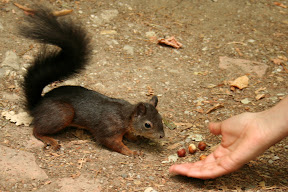
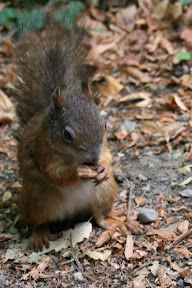
I love the visual power of this expression, because mühsam is exactly the way a squirrel eats a couple of nuts that you feed to it in a park, say in Schönbrunn, in Vienna.