
It's funny how something so simple as a hat can change not only your image but your gestures as well...
We had a very windy evening yesterday and, as I was walking home, I discovered myself holding my hat with my right hand as I was crossing the river, fearing the wind would blow it away. And it struck me that I was just mimicking the very same gesture that thousands of men must have inconsciously made throughout the centuries before me.
All of a sudden, I felt as if I were part of a picture at the turn of the 20th century.
(*) To be honest, I'm not quite sure if my hat is a fedora or a trilby. What do you think?
Showing posts with label thoughts. Show all posts
Showing posts with label thoughts. Show all posts
Saturday, 27 March 2010
Hat

Sunday, 9 August 2009
U
An image, alone, is nothing. Light reflected on different objects, on different materials, that absorb different parts of the rainbow each.
But when this same light crosses our pupils to be projected, upside down, on our retina, there begins the journey of interpretation, the search for meaning. And this is a journey that happens independently in our heads and hence it is something absolutely personal and subjective.
On the long way between the photosensitive cells deep down in our eyes and the formation of a picture, of a memory, of a remembrance in our mind, nerve impulses must travel at lightning speed across thousands of milions of neural connections that are arranged the way they are because this is precisely what makes us how we are, what makes us who we are, and not somebody else.
The image, those thousands of electrical signals that travel across our neurons, takes form in our minds through a process whose complexity we only begin to grasp. This image, or the model of it that exists in our neurons, is checked against hundreds of thousands of other shapes, colours, textures, that we have been linking throughout our lives to feelings, emotions, remembrances, ... meanings. And even though these meanings have a lot to do with our culture, they still are something unique and personal for each individual.
An illuminated blue cube on top of a pole with a white U letter would mean, on every German-speaking country, something as trivial as a subway station (in German, U-Bahn, abbreviation for Untergrundbahn, lit. "underground railway"). In my present situation, on the shores of the Mediterranean, in the city that welcomed me as I was 17 years old, the picture of such a cube has a very different meaning. This U indicates here an ambulance entrance to the hospital where I am writing this post from.
Today this U means for me the battle that I have just witnessed. A battle fought against those evil cells that, at random, out of pure egoism, decide to turn immortal.
Luckily, a battle that has been won.


Saturday, 7 March 2009
Little Things (ii)
(continued from Little Things (i))
Very little and insignificant things have indeed the ability to change our lives. But there is still another quite little thing that, in fact, keeps us alive.
Everyone knows H2O as the chemical formula of water. A chemical formula is a convenient way to count how many atoms of each element are present in a given chemical compound. H2O means that a single water molecule is composed by two hydrogen atoms and one oxygen atom. Now oxygen has two free bonds (valence 2) and hydrogen has one free bond (valence 1). An oxygen atom with its two bonds taken each by a hydrogen atom forms a water molecule.
We can imagine each one of the atoms as a tiny ball, and a chemical bond as an even tinier stick that keeps two of the balls together. Now the oxygen atom is a slightly bigger ball in the middle with two sticks to the sides, each one connected to a hydrogen atom. These two bonds at the sides of the oxygen atom are not perfectly aligned, which would mean a 180° angle, but instead they form a slightly obtuse angle (exactly at 104.45°). Apparently an insignificant fact. But only apparently.
Oxygen has a higher electronegativity (3.44) than hydrogen (2.20), meaning that an oxygen atom attracts electrons much stronger than a hydrogen atom does.
The 104.45° angle between the two oxygen bonds means that one side of the water molecule (the oxygen's side) attracts electrons stronger than the other side (hydrogen atoms' side). We say water molecule has a dipolar nature. A water molecule is, in a way, like a tiny magnet, which has a positive and a negative pole.
(Image taken from Wikimedia Commons)
What happens is that the oxygen side (the negative pole) attracts all electrons in the vicinity, including those electrons in the hydrogen atoms of neighbouring water molecules. That means water molecules are bonded together through its dipolar nature. This kind of bonding is called a hydrogen bond, and it is weaker than a normal (covalent) bond, like the one that keeps a single molecule together. Still, hydrogen bonding among water molecules is responsible for the fact that water is liquid at room temperature, because more heat energy is required to break the hydrogen bonds between molecules.
Now take a moment to think about it. If oxygen had its two free bonds at a 180° angle, there would be no positive and negative side in the water molecule, because the two hydrogen atoms would cancel out the higher electron affinity of oxygen. The boiling point would be much much lower than 100°C. In fact, without hydrogen bonding, water would be a gas at room temperature.
Now imagine all oxygen atoms aligned its bonds at once. That means almost all liquid water on our planet would simply evaporate. Life as we know it would simply cease to exist. At once...
Thank goodness there is that 104.45° angle!


Thursday, 12 February 2009
Little Things (i)
A week ago, our computer started showing signs of sickness: blue screens of death, random behaviour, etc. After trying recovering her the whole week, reinstall the operating system, seeing that it would not help, despairing a little bit, giving it another try, and again and again, we realised it was a defect on one of the RAM modules. We replaced it by a new one and here we are again, after a week without computer.
After all the pain, I was thinking about what a strange thing it is how something so small (certainly not bigger than a thumb's nail!) may have such a big impact in our daily life (because, who are we kidding?, we are nothing without a computer and internet).
I have always felt fascinated by things that, even apparently small and meaningless, have the potential of changing our lives, even forever, or directing the evolution of our society to unexpected places.
In the autumn of 1872, some horses in Ontario, Canada, started showing signs of illness: they could not stand up, violently coughed and had no strength to pull any kind of load. It was the beginning of the 1872 American outbreak of equine influenza, which would spread quickly across the whole East half of North America. Same year's Great Boston Fire was so devastating because all fire department horses were sick and could not move.
This epizootic was one of the major causes of the so-called Panic of 1873, which in turn marked the beginning of the Long Depression, that would last until 1879. The influenza affecting virtually every single horse, economy ground to a halt in a way difficult to imagine: railways came to a halt because no coal could be delivered to locomotives. Men were forced to pull wagons by hand, tramways stopped and basic supplies could not be delivered to the cities.
Some years before, in 1863, one of the ships crossing the Atlantic Ocean brought an unexpected stowaway on its trip back to Europe. So started the spread of Phylloxera throughout the Old World, destroying all Vitis vinifera vineyards after them. In 1877 the plague crossed the Pyrenees and reached for the first time Catalan grapevine crops.
Catalan grape growers had the so-called rabassa morta contracts, by which a farmer had the right to the ground as long as the vines were alive. The European grapevines lasting for about 70 years, a farmer could work on the same field for life. In order to fight the plague, the breeding of Vitis vinifera with resistant native American species was needed, because the latter are naturally Phylloxera resistant. These new species, though, were much more short-lived, around 20 years, what left many young vine growers without fields to work on. Landowners would extend the agreements quite arbitrarily.
Catalan rabassaires suffered a great dissatisfaction and, organised in unions like Unió de Rabassaires, were one of the many factors contributing to the electoral triumph of the Spanish Popular Front (Frente Popular) in 1936. Unfortunately, we all know what came afterwards...
Even though we may see the equine influenza virus or Phylloxera as the villains in these stories, as the ones directly causing that much suffering, I think that the cause of human tragedies lies often in humans themselves, in archaic social structures, in our greed and meanness.
(to be continued...)


Saturday, 31 January 2009
Close encounters
Last summer, as we were in the US North East Coast, we booked for a whale watching tour departing from Portland, Maine. I was very excited about it, because I've read that you are probably never going to forget the first time you meet a whale. You cannot take your eyes off of them, of their blowing breaths, of their majestic flukes as they dive.
Meeting wild animals is always an experience to which we react with an inexplicable joy. This last December I read a very interesting article by Stefan Nink on the Lufthansa Magazin (12/08) that talked precisely about this joy, about what happens when encountering a wild animal in the nature. Nink writes: "[...] Encounters like these hold us spellbound and are fixed forever in our minds. Perhaps because they help us recognize what keeps the world going. Because, for the space of a moment, we have glimpsed something of ourselves."
He goes on to identify the cause of such reaction: "Psychologists can explain why encountering animals in nature affects us so profoundly. Humans, they say, are burdened with a permanent, subconscious regret at having cut ourselves off from nature as we evolved. That's why we experience such joy when we unexpectedly meet an animal face to face. They also say that part of our consciousness recognizes an ancient relative."

I have been lucky enough to have met a number of wild animals. Living so close to the nature, it is relatively easy, but not a bit less intense. There is something about watching animals in the nature that produces in us the same magical attraction that fire does.
Nink finishes his article beautifully: "Sometimes animals seem to have something that humans no longer possess, seem to know something nobody else does, except perhaps the wind. Sometimes we sense something of their power and superiority. Like when we look into the eyes of a lion or a tiger, or when, while hiking in South America, the sky momentarily darkens as the shadow of a condor passes overhead. This type of encounter is like a mystery revealed, and it will often make you feel as if the finger of creation had gently tapped you on the shoulder. An encounter like this may make you think about just how we humans treat the world, and if it wouldn't be a better place without us."
So, back in Portland, Maine, we were all set for the whale watching tour. But unfortunately, some twenty minutes after leaving the port, the captain decided we had to turn around and get back to port.
There was way too much fog to see anything...


Thursday, 25 September 2008
The American Way
When travelling to the United States, Lufthansa offers some practical advice on how to complete the I-94W immigration form. Among other tips, it is recommended for European visitors to write numbers the American way, and not the European way, so that no misunderstanding can happen with immigration officers.
In spite of a lot of striking similarities, especially if you compare North-Eastern America with Central Europe, there is still an awful lot that's done differently on each side of the Atlantic Ocean.
The one thing that appeared most evident to me is that North Americans talk. A lot. It does not really matter if they know you or not. They are eager and willing to talk to table neighbours in a bar, spontaneously offer help if you just seem to be a little lost, ask you about your country or, simply, listen to your story. Someone told me that if you ask an average North American for the time, you have already made a new friend. And it seems to be true. Not only in lovely small towns at the heart of a National Park, but also in big cities (so big, in fact, that some might consider them capital of the western world).
This US people feature might be somewhat surprising to us residents of the Old World, where everyone tends to mind her or his own business and don't care about the others'. Confronted with the true masters of small talk, we felt a little strange at first. But we quickly recognised the advantages of giving conversation to people. Because thanks to perfect strangers that were willing to talk to us, we have been to places that we would never have discovered otherwise.
I think the greatness of this attitude is that it ends up in win-win situations quite often, in which both parties get something useful. And even nothing more but a friendly conversation with no obvious chance for anyone, it is still a nice experience. Either way, such an approach to social relations lets North Americans being open to new opportunities, to unexpected chances, practising actively the so-called "networking". Its principle is to establish contacts between people you know, who might be interested in knowing each other, whatever the reason. That way, the tremendous power of exponential growth is put to work for us.
A week before travelling to the States, I was waiting to get my international driving license at the ÖAMTC (the Austrian Automobile Association) in Salzburg. An old lady in front of me was asking for road information for her vacation, and I heard she asked about destinations on the coast between Barcelona and Tarragona. I smiled and waited for my turn. As I later got my license and went out, I saw she was still there at the parking lot, and I thought on approaching her and tell her that Tarragona is my birthplace and offer her some more advice. But, you know, I'm a little shy and do not feel really comfortable starting conversations with strangers, so I just unlocked my bike and rode away.
And I almost immediately regret not having talked to her, because nothing bad could have happened, she would have get first-hand information about the region from a native and, who knows?, probably I would have got something from her, even just the satisfaction of helping someone would have been fine. But no.
Maybe next time?


Wednesday, 25 June 2008
Vecchi porti
There are places in the world where peace of mind is easily achieved. Places where the sea embraces tenderly the people that settled at her shores centuries ago. Aged cities. Old harbours. Wise people.
Cities, like Trieste, where I feel like I were home, even though, until this last weekend, I had never been there before. Towns, like Muggia, that lull me gently, in a way I never felt up North, in Central Europe. 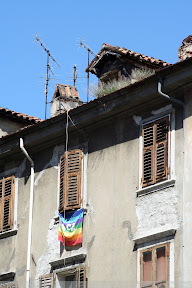
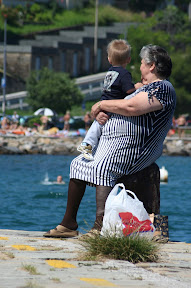
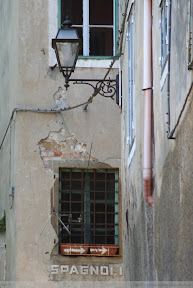
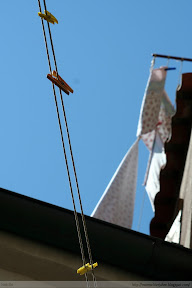
Aged buildings, shabby walls, familiar people, broken windows, laundry, narrow alleys, street lamps, all those things that you miss when you are living in CandyLand, where you still look for the stage machinery behind the scenes...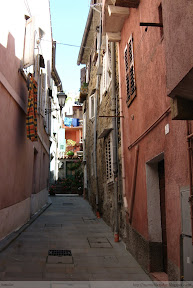
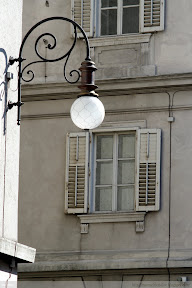
The charm of towns and cities of a modest past, whose History does not include great wealth that would have allowed frequent reconstruction of its buildings, but left their loveliness untouched and let them keep a genuineness that the others, those keeping up with the last architectural tendencies, lost long ago.
And of course the Mediterranean, which welcomes us once again, this time with a new face, but always the same, always the one whose water caressed my skin so often. The sea and all her rig that are, without any extra effort, main characters of the best pictures in the world.
By the way, I found those ears again...


Sunday, 15 June 2008
About gravity and time perception
Thanks to the internet, we can meet much more people today than we could if it would not exist. Meet them, take a brief look at their lives or follow their thoughts with interest. Anyway, for those who always felt a little geeky, those who wouldn't play football at school, those who rather kept quiet when the teacher asked something, for all of us, the internet makes us aware of our comforting averageness, after taking a look out there...
I've always liked to make up theories about why things are the way they are. Most of them are nothing but pure crap, but some of them, the oldest ones, achieved to me a status, maybe not of irrefutable truths, but at least theses for which a counter-example is yet to be found.
One of my favourites is the subjective perception of time, and how Newton mechanics comes in hand to explain it. Some time ago, it was remarked how spring and summer go away too fast. If we imagine the year as a circle, divided more or less uniformly in 12 sectors, corresponding to the 12 months, if we assume December and January at the top, we put it upright and we imagine time going by as a little ball rolling on it under gravity's action, it is then easy to understand why spring goes away so fast (the ball falls almost free from April on), why does summer, too (with all the drive from spring, September is already there before we can realise it), why is it so hard to pass from October to January (going uphill!), and why we start feeling more perked up from March on (gravity starts to pull us down).
Other time intervals can be explained with this approach as well: working hours (uphill from 8:00 to 12:00, downhill from 13:00 to 17:00, although sometimes the whole thing turns upside down, I don't really know why...) or the week (Saturday and Sunday at the bottom, Wednesday on top).
And I wonder, if we were on the Moon, where gravity is weaker, would we feel less difference between spring and autumn? Or, if we stayed on Earth, is the ball's movement affected by tides?

Sunday, 1 June 2008
Waiting for the rain
The Mediterranean coastline is a hard piece of ground.
One of the first things that strucks the Mediterranean expatriate on arriving to Austria is the greenness, that incredibly saturated green colour, almost supernatural, whose brightness hurts those eyes that grew accustomed to red ochre ridges, yellow brooms, infinite blue sea and dusty green olive trees.
Soon after moving to Austria one realizes where does the green come from: flora has a rather easy life on this land because it rains often and abundantly. That's why trees can turn into 30 and 40 meter tall giants. That's why going into the woods outside paths is almost mission impossible in spring and summer, save you have a machete.
The Mediterranean coastline, I was saying, is a hard piece of ground. Because rain is there a really scarce good that, when it falls, does so in a short and wild way over a very dry ground that cannot soak it up and ends up causing floods instead of producing crops.
But Mediterranean vegetation, as are its people, is old and wise and learned to wait, keeping all their energies for that couple raindrops that are going to fall, if not today, maybe tomorrow, or next week, or next month. And when those raindrops do eventually fall, they get strength out of nowhere, throwing roots to drink them, sprouting little shoots that will let them continue saving that light, that Sun, saving energy for the next drought.
I think Mediterranean vegetation is fascinating because of the way it holds on anxiously to life and carries on in spite of a rather hostile environment. I love it because it reminds me of its people, it reminds me of my people, who turned barren into cultivated land with sweat, blood, effort and resolution, under the remorseless Sun that burns everything out.
Last week we have been to Catalonia. As we came back, my office colleagues asked me, as usual, if we'd had nice weather. And I told them yes, it'd rained every day and that's the best weather we could have wished for. I'm not sure that they really understood my smile and the joy I felt in my heart as I saw my land green and alive.


Sunday, 30 March 2008
Frames
One of my favourite scenes in “Lord of the Rings: Return of the King” has the four hobbits drinking a pint at The Green Dragon as they listen to Ted Arenas's blusters. They share a look of mutual understanding and a rather sad smile. They saved Middle Earth from Sauron's Chaos and Darkness but they cannot tell anyone back home, because no one would understand. They feel, as do war veterans and survivors of all kinds, different, strange and awfully alone. Life and people in The Shire did not change at all, but they did. What had always been "normal" for them isn't normal any more.
One of the last times we were in Spain we felt, for the first time, something which, I think, might be quite common among the expat community. Everything looked strange, unfamiliar. We had a hard time understanding what people was doing. We felt almost “stranger”. Why did everyone talk so loud? What were they doing? How could they play such loud music everywhere? All of them are things we did not really realize when we were living there. Because they were “normal” then. But they aren't any more.
After two or three days the feeling was gone, all we needed was a little readjustment. But it made me realize how dependent we are on our references, on our frames, and how little we know about this dependency.
What is considered “normal” is so fragile that changes happening without stop go unnoticed. Our frames evolve continuously and we don't realize they changing. That's why such words like "normal", "common sense", "logic", "it goes without saying" might be dangerous, as well as arguments that base on them. Because my frames are not necessarily the same as yours, maybe not even close. And we would better not refer to a supposedly common frame which, for practical effects, doesn't need to exist.
To finish, a bit of music. The suite "Estaciones Porteñas", written by Argentinian composer Ástor Piazzolla, consists of four parts, one for each one of the seasons, as kind of a tango counterpart to Vivaldi's "Four Seasons". Like them, each of the tangos evokes the corresponding season. "Verano Porteño" (summer) is a lively tango, and it seems to me as vibrant as a snow storm, while "Invierno Porteño" (winter) has a slow and sad melody that makes me think of the never ending hours of a hot sunny afternoon. Now, "porteño" refers to the city of Buenos Aires. Should I blame my frames because I think the titles and the music do not match? Or is it a wink from Piazzolla's South to northern hemisphere's seasons?
But I am going to stop talking now, to let El Gran Ástor's bandoneón speak.


Sunday, 16 December 2007
The Source of All Things
When you decide to move to another country, it has to be clear that there is a lot of things that you are going to miss. Besides your friends and family, of course, most of the things that you are going to end up missing are quite surprising, because they are quite trivial, like fried corn, the music of a jackpot machine in a bar or water-filled ashtrays, and because you realize that you miss them the first time you see them again.
Other things you know you are going to miss from the very beginning. Before moving to Austria I told someone here that one of the things that I was going to miss the most was the sea. He looked at me with a strange look on his face and he told me that I should not worry, because there are lots of lakes here in which one can go swimming in summer. All right. Great. It is not what you can do on the sea what I miss. I miss the sea. Just like that. But they don't get it. Maybe because they are not able to understand it at all.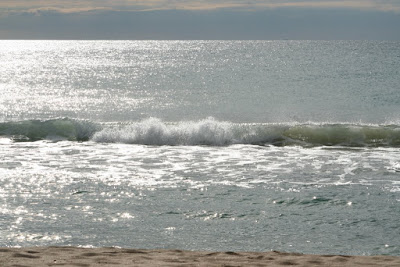
But I am not alone. I know there's someone who understands me. I get understanding from my friend K's blue eyes, where I am able to see the sun reflection on the North Sea over the bow of his Phaleron. I get understanding from the sarcastic smile of a Swedish girl, who asked herself what is really the point of all those Germans who buy themselves a boat to sail around a lake.

But, what is it about the sea? Why do we all who grew at its shores miss it so much? Why do we feel so attracted to the sea?
My mother always told she needs the sea because it is an escape way. Because knowing that the sea is there, she does not feel trapped on solid ground. She might have something there, but I believe there is a deeper reason.
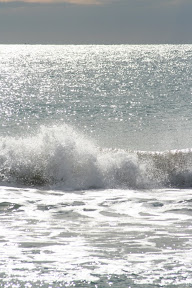
Because the sea is the source of everything. The sea gave us life millions of years ago, and it keeps us alive ever since. It is the sea who gives us our bread. As I look at the sea, I marvel at its incredible beauty, and I could spend hours and hours watching, listening to the waves breaking onto the cliffs, letting the smell of the salt into me, stepping down in respect in front of its infinite power. As I look at the sea I think that everything began just there. And it is still there, after all that happened, and this provides a security and cosiness quite similar to the one you might feel going home. Because I think that the sea is, actually, our home.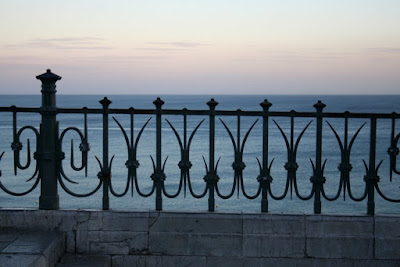
I live far away. But I know it's there, and I just need to close my eyes to see the colours, to hear the waves letting their white hair go before dying on the sand with a murmur.
Saturday, 17 November 2007
Brot + Spiele
During last summer's Salzburg Festival, a number of stickers were found around the city, on traffic signs, bus stops and doors. They mocked the official logo of the Festival with the words Salzburger Brot+Spiele (bread and circuses) instead of the original Salzburger Festspiele. At first I did not understand what it was about, but Mar explained to me that "bread and circuses" was used in the Late Roman Empire, referring to the fact that, providing your people with enough food and distractions is a very successful way to avoid them from questioning the fairness of their governors. The stickers claimed that politics in Salzburg seem to be all about one single event (the Festival), from which the population does not really take a significant benefit, which diverts a lot of resources from other more important topics, like housing, or social issues.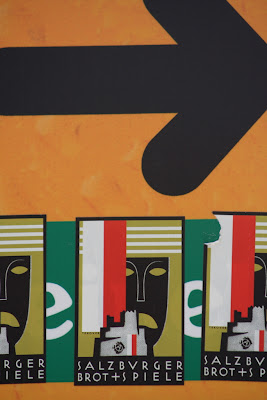
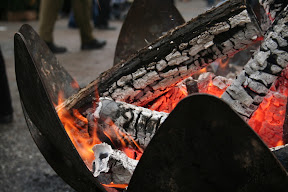
When I hear people saying that Humanities are not useful, that they are of no practical use for our daily life, it always makes me very sad. Because I think that Culture, having some knowledge about our world, about our History, allows us having a little more idea about who we are, why we are here, where we are going to. We live in a world that appraises technical knowledge above all, as if it were the only valid knowledge. Technical knowledge is good, everyone should know about s = 2πr and F = ma, but everyone should know as well who Plato, Cervantes, Leonardo, Descartes were, and why are they important. Because that kind of knowledge makes us more robust against smoke merchants, against unfairness, against random will. Because Culture is like a torch, that brings light into the never ending darkness, that lets us make a fire to keep us warm while it is so cold out there...
And I think one must be curious about things, and one has to keep oneself always eager to learn. It's something like not loosing the natural curiosity of children, always wanting to learn a little more, always wanting to know why. Sometimes my Austrian friends are surprised because I know facts about Austria, about Salzburg, that they didn't know. I do not think that there is something so special, it's just that I am still curious about the world around me.
I have to thank my parents for the seed to this curiosity, although they might not be fully aware of it. I always loved reading, and I use to read in bed before I sleep (almost always I fall asleep on top of the book! :)). When I was 12 we used to live in a quite small flat, and there wasn't really much place to keep stuff. My parents bought an encyclopedia, and the only free spot by then was in my room, directly above the head of my bed. When I went to sleep and I had no book to read (which happened quite often) I would just randomly pick a volume from the encyclopedia, open it and read whatever catched my eye first. Some topics were boring, but others were quite interesting, and I leaped back and forth searching for a related topic, and another, and yet another. It was like entering a huge Library before sleeping, learning something new every night. Sometimes my “research” would last for more than an hour and I would be sleepy the day after, but it was definitely worth it. I think with that encyclopedia my parents made me, quite inadvertently, one of the best gifts I've ever had.
I am happy I never lost that curiosity. And now, with the exponential possibilities that the Net puts in our hand, my “research” acquired a new dimension: Google and Wikipedia are two of my best friends. Because you are just one click away from the next discovery, one single click away from you entering a new room of the Library.
A whole new world of knowledge is just one click away from us. Are we going to let this chance go?
PS: Our internet connection is not fixed yet. It seems it got a cold, and you know, they are quite bad this time of year. Not being able to answer random questions that keep coming to my mind is driving me crazy!
Subscribe to:
Posts (Atom)
 versión en español


