
It's funny how something so simple as a hat can change not only your image but your gestures as well...
We had a very windy evening yesterday and, as I was walking home, I discovered myself holding my hat with my right hand as I was crossing the river, fearing the wind would blow it away. And it struck me that I was just mimicking the very same gesture that thousands of men must have inconsciously made throughout the centuries before me.
All of a sudden, I felt as if I were part of a picture at the turn of the 20th century.
(*) To be honest, I'm not quite sure if my hat is a fedora or a trilby. What do you think?
Showing posts with label feelings. Show all posts
Showing posts with label feelings. Show all posts
Saturday, 27 March 2010
Hat

Saturday, 11 July 2009
Saturday, 30 May 2009
Missing you...
Since I went away I have been missing you. Strange, isn't it? Before meeting you I expected I would like you a lot, but I could not advance that I would be attracted to you so bad that I would want for you from the distance.
Lately the wish that has been there all these months is changing to a biting yearning to which I do not seem to find a remedy.
Damn you, dumb American TV series!

Saturday, 9 May 2009
1993 - 2009
Never again will you wait until everybody has sit down to eat to ask going out.
Never again will you fall asleep in an impossible position.
Never again will you follow the one who's sweeping the floor in order to check if it is done properly.
Never again will you raise your head and close your eyes when I scratch you under your chin.
Never again will you chase my feet when I'm wearing slippers.
Never again will you run in circles around the flat in your daily five minutes of madness, from the living room to the balcony, to the bedroom, to the corridor, to the living room, ...
Never again will you call from the door for the one who's just gone out to take out the rubbish.
Never again will you have that ironic look in your golden eyes, as if you already knew everything.
Never again will you ask someone to turn the tap on for you to drink water.
Never again will you gently lick our finger tips with your scratchy tongue.
Never again will you miaow us to complain when we come back home after having left you alone for one or two days.
Never again will you rub your head on my knees as I duck to say hello, recognising me every time I come back home and marking me as your property once again.
Never again will you threateningly hiss guests who try to stroke you on your back.
Never again will you hide your paws under your body if it's cold.
Never again will you foretell my mother's intention nor will you ever run again to hide under the bed before she gets you into the bathtub.
Never again will you get yourself into paper bags nor will you ever again be afraid of plastic ones.
Never again will you quietly ask us for food as we eat, gently touching our arms with your paw.
Never again will you go out to scout the stair landing, the most mysterious part of your indoors world.
Never again will you keep us in suspense as you walk on the railing of the balcony.
Never again will you fall down to the courtyard from a third floor and get only a scratch on your snout.
Never again will you leave the thinnest grey hairs on our clothes.
Never again will you set up a big fight every time we take you to the vet.
Never again will you fall asleep on our coats just minutes before we have to leave.
Never again will you make us worry about your ageing ailments and the bad health of your kidneys.
Never again will I marvel at the softness of your fur as I stroke you nor will you ever again show your acknowledgement by purring.
I know that the next time that I'm home, in Tarragona, my heart will hope to find you behind any door, but I will never see you again.
Now sleep, sleep forever, sweet Grisona. Go back to the soil and keep shining in our memories.


Saturday, 4 April 2009
Conservationism
Lately I have found myself thinking and reading about life on our planet, about its first babbles, its current state and its future.
My awareness for conservationism has been shaped by readings and curiosity about the environment since my teenager years. But I think the true roots of this awareness, my realising the role we humans play about Nature, lay way back in the past, in my childhood, with two songs written by Joan Manuel Serrat, a Spanish Catalan singer that is part of the subconscious psyche of almost all members of my generation, thanks to our parents and the miracle of gramophone and compact cassette.
Pare digueu-me què li han fet al riu que ja no canta. Rellisca com un barb mort sota un pam d'escuma blanca. Pare que el riu ja no és el riu. Pare abans que torni l'estiu amagui tot el què és viu. Pare digueu-me què li han fet al bosc que no hi ha arbres. A l'hivern no tindrem foc, ni a l'estiu lloc on aturar-nos. Pare que el bosc ja no és el bosc. Pare abans de que es faci fosc tanquem la vida al rebost. Sense llenya i sense peixos, pare, ens caldrà cremar la barca, llaurar el blat entre les runes, pare, i tancar amb tres panys la casa, Ai, dèieu vostè... Pare si no hi ha pins no es fan pinyons ni cucs ni ocells. Pare si no hi ha flors no es fan abelles, cera ni mel. Pare que el camp ja no és el camp. Pare del cel avui ens plou sang. El vent ho canta plorant. Pare ja són aquí! Monstres de carn amb cucs de ferro. Pare no, no tingueu por, digueu que no, que jo us espero. Pare que estan matant la terra. Pare deixeu de plorar que ens han declarat la guerra. | Father, please tell me what have they done to the river that it doesn't sing anymore? It runs like a barbel dead under a handspan of white lather. Father, the river is not the river anymore. Father, before Summer comes again hide all that's alive. Father, please tell me what have they done to the woods that there are no trees? In winter we won't have fire, and in summer no place for us to rest. Father, the woods are not the woods anymore. Father, before it gets dark let us store life in the larder. Without firewood and without fish, father, we'll have to burn the boat, grow wheat among the rubble, father, and use three locks for the house, Oh, would you have said... Father, if there's no pine trees there'll be no nuts no worms, no birds. Father, if there's no flower there'll be no bees, no wax and no honey. Father, the fields are not the fields anymore. Father, it rains blood from the sky today. The wind sings about it crying. Father, they are here! Flesh monsters with their iron worms. Father, no, don't be afraid, and say no, I'm waiting for you. Father, they're killing the earth. Father, please stop crying because they've declared war on us. |
This sond, as I was saying, resides so deeply in my subconscious, so stuck in my soul, that big tears run down my cheeks every time I listen to it. The same happens with the next song, Plany al mar (Lament to the sea).
Bressol de vida, camins de somnis, pont de cultures, ai!, qui ho diria, que ha estat el mar? Mireu-lo fet una claveguera, mireu-lo anar i venir sense parar. Sembla mentida que en el seu ventre es fés la vida. Ai!, qui ho diria sense rubor? Mireu-lo fet una claveguera ferit de mort. De la manera que el desvalissen i l'enverinen, ai!, qui ho diria que ens dóna el pa? Mireu-lo fet una claveguera, mireu-lo anar i venir sense parar. On són els savis i els poderosos que s'anomenen ai!, qui ho diria, conservadors? Mireu-lo fet una claveguera ferit de mort. Quanta abundància, quanta bellesa, quanta energia, ai!, qui ho diria?, feta malbé. Per ignorància, per imprudència, per incosciència i per mala llet. Jo que volia que m'enterressin entre la platja, ai!, qui ho diria?, i el firmament. I serem nosaltres, ai!, qui ho diria? els qui t'enterrem. | Cradle of life, paths of dreams, bridge of cultures. Who would have thought it? That has been the sea. Look at it looking like a sewer. Look at it coming and going without stop. It's hard to believe that in its womb life was created. Who could now say that without a blush? Look at it looking like a sewer, fatally wounded. Looking at the way that it is stripped bare and poisoned, who could believe it gives us our bread? Look at it looking like a sewer. Look at it coming and going without stop. Where are the wise and the mighty ones that they call themselves, who would have thought, conservatives? Look at it looking like a sewer, fatally wounded. So much abundance, so much beauty so much energy, who would have thought?, totally ruined. Out of ignorance, out of imprudence, out of irresponsibility and out of meanness. I wanted to be buried between the beach, who would have though?, and the firmament. And it will be us, who would have thought?, the ones who'll have to bury you. |
Sunday, 29 March 2009
Hoping for new life
I already told you about my struggle on growing Mediterranean tree species in Austria. Well, our orange trees are doing pretty well, but I am starting to loose my faith on the survival of the pine tree. I think it might have frozen as we were in Spain last Christmas.
I'm afraid the day will come when I'll have to accept the evidence and throw my little pine away. Knowing that I will be very sad about it, I decided to make up to myself for it by letting new life sprout before the day comes. Just in case.
It all started in the Paleoproterozoic, around 3000 million years ago, as the ice cap of the Makganyene glaciation (which might have covered the whole planet) retreated and left space for a vast ancestral ocean.
Two types of living organisms survived under the ice and rapidly populated this ocean. Archaea, which used several sources of energy such as sulphur or ammonia and produced methane as waste product, and a new kind of bacteria, the Cyanobacteria, able to obtain their energy through photosynthesis, a process that converts sunlight and carbon dioxide (CO2) into energy, releasing oxygen (O2) as a waste product.
These cyanobacteria were so successful at reproducing and colonising the ocean that they actually changed the composition of the atmosphere and were going to shape the world for the next 3000 million years. Before cyanobacteria existed, there was not much oxygen in the atmosphere. Free oxygen in large amounts was in fact poisonous to most of the living creatures at the time, especially to archaea. Most life on Earth vanished in what is known as the Oxygen Catastrophe(*).
But serious stress factors like this great oxidizing event are notably the source of big evolutionary pushes: a whole new kind of bacterial organisms evolved, aerobic bacteria, which used oxygen (now available in huge amounts) as a source of energy, producing carbon dioxide as a waste product. And that's not all. By an outstanding touch of genius, some Archaea, facing a serious problem in this new and poisonous oxygen-rich environment, incorporated cyanobacteria or proteobacteria (a kind of aerobic bacteria) through the cellular membrane into their cellular bodies and used part of the energy produced by them to keep themselves alive. This brilliant trick, known as endosymbiosis, would be the origin of the eukaryotic cells, which contain several membrane-bound structures, each one specialising in a different function.
Those Archaea that associated with aerobic bacteria (which needed oxygen) were the basis for the fauna, to which we humans (**) belong as well. From Archaea that associated with cyanobacteria (which produced oxygen through photosynthesis) would originate the flora, that is, multi-celled living creatures able to obtain energy from sunlight through photosynthesis.
I've been thinking about this long story, this long evolutive path, as I was sowing orange and lemon seeds to give plant life another chance. Now wake up!, you little seeds. Wake up from your long sleep, let sunshine and water put you in alert and consummate once again the miracle of life for me!
(*) This Oxygen Catastrophe in the Paleoproterozoic raised the atmospherical oxygen concentration to 4%. To reach the current level of 21% a colonisation of the land masses by plants and woods would be needed.
(**) Not all Archaea disappeared in the Paleoproterozoic. In fact, a great number of them are alive and well, living in the most incredible places. Big colonies of Methanobrevibacter smithii, for instance, live in the human gut and help us with digestion.
(***) Taronger is the Catalan word for "orange tree".

Friday, 20 February 2009
It snows
I love it when it snows.
Because your usual pathways are disguised in white and you have to follow the footprints of others before you to walk along them.
Because if you look at your coat close enough, you might see perfectly formed snow crystals, whose beauty will for sure captivate you.
Because the quietness is almost supernatural. I can hardly imagine of anything more relaxing than looking at the snow falling through a window.
Because I cannot resist passing my hand over the freshly fallen snow.
I really love it when it snows.


Saturday, 31 January 2009
Close encounters
Last summer, as we were in the US North East Coast, we booked for a whale watching tour departing from Portland, Maine. I was very excited about it, because I've read that you are probably never going to forget the first time you meet a whale. You cannot take your eyes off of them, of their blowing breaths, of their majestic flukes as they dive.
Meeting wild animals is always an experience to which we react with an inexplicable joy. This last December I read a very interesting article by Stefan Nink on the Lufthansa Magazin (12/08) that talked precisely about this joy, about what happens when encountering a wild animal in the nature. Nink writes: "[...] Encounters like these hold us spellbound and are fixed forever in our minds. Perhaps because they help us recognize what keeps the world going. Because, for the space of a moment, we have glimpsed something of ourselves."
He goes on to identify the cause of such reaction: "Psychologists can explain why encountering animals in nature affects us so profoundly. Humans, they say, are burdened with a permanent, subconscious regret at having cut ourselves off from nature as we evolved. That's why we experience such joy when we unexpectedly meet an animal face to face. They also say that part of our consciousness recognizes an ancient relative."

I have been lucky enough to have met a number of wild animals. Living so close to the nature, it is relatively easy, but not a bit less intense. There is something about watching animals in the nature that produces in us the same magical attraction that fire does.
Nink finishes his article beautifully: "Sometimes animals seem to have something that humans no longer possess, seem to know something nobody else does, except perhaps the wind. Sometimes we sense something of their power and superiority. Like when we look into the eyes of a lion or a tiger, or when, while hiking in South America, the sky momentarily darkens as the shadow of a condor passes overhead. This type of encounter is like a mystery revealed, and it will often make you feel as if the finger of creation had gently tapped you on the shoulder. An encounter like this may make you think about just how we humans treat the world, and if it wouldn't be a better place without us."
So, back in Portland, Maine, we were all set for the whale watching tour. But unfortunately, some twenty minutes after leaving the port, the captain decided we had to turn around and get back to port.
There was way too much fog to see anything...


Wednesday, 25 June 2008
Vecchi porti
There are places in the world where peace of mind is easily achieved. Places where the sea embraces tenderly the people that settled at her shores centuries ago. Aged cities. Old harbours. Wise people.
Cities, like Trieste, where I feel like I were home, even though, until this last weekend, I had never been there before. Towns, like Muggia, that lull me gently, in a way I never felt up North, in Central Europe. 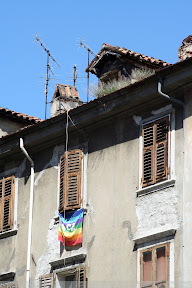
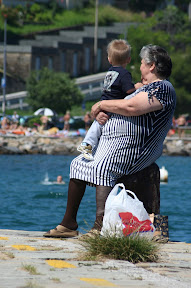
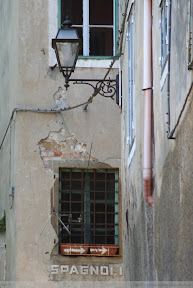
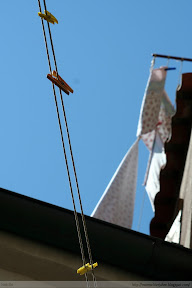
Aged buildings, shabby walls, familiar people, broken windows, laundry, narrow alleys, street lamps, all those things that you miss when you are living in CandyLand, where you still look for the stage machinery behind the scenes...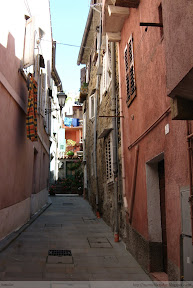
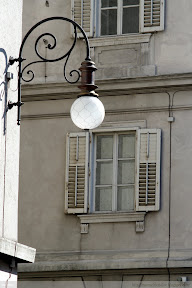
The charm of towns and cities of a modest past, whose History does not include great wealth that would have allowed frequent reconstruction of its buildings, but left their loveliness untouched and let them keep a genuineness that the others, those keeping up with the last architectural tendencies, lost long ago.
And of course the Mediterranean, which welcomes us once again, this time with a new face, but always the same, always the one whose water caressed my skin so often. The sea and all her rig that are, without any extra effort, main characters of the best pictures in the world.
By the way, I found those ears again...


Sunday, 1 June 2008
Waiting for the rain
The Mediterranean coastline is a hard piece of ground.
One of the first things that strucks the Mediterranean expatriate on arriving to Austria is the greenness, that incredibly saturated green colour, almost supernatural, whose brightness hurts those eyes that grew accustomed to red ochre ridges, yellow brooms, infinite blue sea and dusty green olive trees.
Soon after moving to Austria one realizes where does the green come from: flora has a rather easy life on this land because it rains often and abundantly. That's why trees can turn into 30 and 40 meter tall giants. That's why going into the woods outside paths is almost mission impossible in spring and summer, save you have a machete.
The Mediterranean coastline, I was saying, is a hard piece of ground. Because rain is there a really scarce good that, when it falls, does so in a short and wild way over a very dry ground that cannot soak it up and ends up causing floods instead of producing crops.
But Mediterranean vegetation, as are its people, is old and wise and learned to wait, keeping all their energies for that couple raindrops that are going to fall, if not today, maybe tomorrow, or next week, or next month. And when those raindrops do eventually fall, they get strength out of nowhere, throwing roots to drink them, sprouting little shoots that will let them continue saving that light, that Sun, saving energy for the next drought.
I think Mediterranean vegetation is fascinating because of the way it holds on anxiously to life and carries on in spite of a rather hostile environment. I love it because it reminds me of its people, it reminds me of my people, who turned barren into cultivated land with sweat, blood, effort and resolution, under the remorseless Sun that burns everything out.
Last week we have been to Catalonia. As we came back, my office colleagues asked me, as usual, if we'd had nice weather. And I told them yes, it'd rained every day and that's the best weather we could have wished for. I'm not sure that they really understood my smile and the joy I felt in my heart as I saw my land green and alive.


Sunday, 18 May 2008
Details
Sometimes our feelings follow paths that we don't understand. Sometimes our perception happens at levels that we are not able to trace.
Why are there cities that appear cold? What is that small bit of something that, in spite of all the good, doesn't let you feel quite like home?
Why are there other cities that seem to embrace you with its charme? What is that other something that gives you the feeling you could easily make of that city your home?
I don't know. Maybe it's just the colour of its rooftops...


Monday, 12 May 2008
Follow your nose
One of the consequences of the enormous evolutive success of the human species has been the loss of contact with Nature. We live in stone boxes, some meters above the ground, days and days can go on without ever touching any soil with our hands, we drink bottled water and almost everything we eat comes on white trays in plastic wrap.
Some of our forefathers' abilities disappeared (as most surely our toes will do). Others are still there, but I do not believe they would be of any use now, had we have to survive and succeed in the hostile environment the first great apes lived in.
Yesterday I was thinking about that as I discovered, on a bicycle tour along the Danube river banks, some cereal ears. I'm pretty sure they are the same ears with which I played as a kid in school. We ripped them off with our pointing finger and thumb (I still can clearly remind the noise they made) to throw them to the other kids, because they would stick to the clothes, especially to wool pullovers. (*)
I was very aware of how the memory was built in my mind, first seeing the ears at the path sides, then picturing myself ripping them off, then touching them, then remembering the noise, and then the warmth of the memory...
On the other hand, when it is a smell that reminds me of something, it comes to me almost immediately, as if the nose had direct line with the memory. Although they seem to be lost memories, they just need the right smell to be made appear sharply, with every little detail, as if I was living that again.
I always thought I have a good sense of smell. I suppose it is to made up for my short-sightedness and a certain increasingly hearing loss. I think smell is one of the most directly connected senses to our brain. Not to the most "conscious" part of it, but to that almost "reptilian" brain that controls our instincts. Because smell was already there before consciousness appeared, and memory was probably there, too.
I like bicycling to the office because, on this time of year, I am able to smell wild garlic even not being able to see it (did I mention my short-sightedness?). I like the different smells that fill up Salzburg's passages depending on the day of the week, depending on the time, depending on the passage. The passage going from Mozart's birthplace and Universitätsplatz smells of coal and sausages every Saturday noon. Close to Konditorei Schatz it always smells of cakes. Balkan Grill's passage always salutes our noses with the smell of a misterious spice blend and Nagano Restaurant's passage smells of soya sauce and seaweed.
I like the sense of smell, because it is proof of our past in the wilderness, as being able to distinguish a threatening smell from the smell of food could mean survival or death. Because it reminds us that we are nothing but little animals, somehow evolved, but still animals. I like it because my heart misses a beat when I smell the loved one behind me. I like it even though sometimes, when people use too much perfume, I almost can't breathe in the lift. I like the sense of smell because, sometimes, it brings about memories of my childhood, as we threw those cereal ears to each other, as we had not started chasing girls yet...
(*) Mar says they called them the boyfriend plants, because the number of ears sticking to you was the number of boyfriends you had...


Saturday, 26 April 2008
Books on the tramp
If there is a day when I miss being in Catalonia it is April the 23rd, Diada de Sant Jordi and World Book Day. It is an old Catalan tradition to give a rose and a book to the loved one. Last Wednesday I longed all day for the smell of the roses and the never ending bookseller stands all over La Rambla.
It is World Book Day because Miguel de Cervantes died on April 23rd 1616, and so did William Shakespeare (funnily enough, though, and thanks to the late British adoption of the Gregorian calendar, they died ten days apart!). Garcilaso de la Vega died on an April 23rd, and Shakespeare himself was born on a 23rd April, too, so everything pointed to this day.
And thinking of books, I remembered I wanted to tell you about BookCrossing. Are you ready to enter the biggest library in the world? Do you enjoy reading? Would you like to do it for free? Are you up to have some fun without leaving your city? Take a look at their website!
I love such crazy ideas, those initiatives that are based exclusively in people's good will and brotherhood. And though they work. And they make me regain faith in the future of mankind every day. Last week we catched two new books. Someone released them just on our supermarket's windowsill. That easy.
Plus, Mar gave me a rose and a new book for the Diada, and I gave a rose and a book to her. We've been doing so every year since we are here. My parents told me that they have another book for me, too.
So, I guess I have some homework to do now.

Sunday, 30 March 2008
Frames
One of my favourite scenes in “Lord of the Rings: Return of the King” has the four hobbits drinking a pint at The Green Dragon as they listen to Ted Arenas's blusters. They share a look of mutual understanding and a rather sad smile. They saved Middle Earth from Sauron's Chaos and Darkness but they cannot tell anyone back home, because no one would understand. They feel, as do war veterans and survivors of all kinds, different, strange and awfully alone. Life and people in The Shire did not change at all, but they did. What had always been "normal" for them isn't normal any more.
One of the last times we were in Spain we felt, for the first time, something which, I think, might be quite common among the expat community. Everything looked strange, unfamiliar. We had a hard time understanding what people was doing. We felt almost “stranger”. Why did everyone talk so loud? What were they doing? How could they play such loud music everywhere? All of them are things we did not really realize when we were living there. Because they were “normal” then. But they aren't any more.
After two or three days the feeling was gone, all we needed was a little readjustment. But it made me realize how dependent we are on our references, on our frames, and how little we know about this dependency.
What is considered “normal” is so fragile that changes happening without stop go unnoticed. Our frames evolve continuously and we don't realize they changing. That's why such words like "normal", "common sense", "logic", "it goes without saying" might be dangerous, as well as arguments that base on them. Because my frames are not necessarily the same as yours, maybe not even close. And we would better not refer to a supposedly common frame which, for practical effects, doesn't need to exist.
To finish, a bit of music. The suite "Estaciones Porteñas", written by Argentinian composer Ástor Piazzolla, consists of four parts, one for each one of the seasons, as kind of a tango counterpart to Vivaldi's "Four Seasons". Like them, each of the tangos evokes the corresponding season. "Verano Porteño" (summer) is a lively tango, and it seems to me as vibrant as a snow storm, while "Invierno Porteño" (winter) has a slow and sad melody that makes me think of the never ending hours of a hot sunny afternoon. Now, "porteño" refers to the city of Buenos Aires. Should I blame my frames because I think the titles and the music do not match? Or is it a wink from Piazzolla's South to northern hemisphere's seasons?
But I am going to stop talking now, to let El Gran Ástor's bandoneón speak.


Saturday, 19 January 2008
Sounds of destruction
Every Saturday, exactly at 12:00 a.m., the city alarms of Salzburg (and, apparently, those of every city and town in Austria) are tested for half a minute. Their sound, loud and continuous, always remembers me of air raid alarms. It might well be that they are the old WWII bomb alarms, reused as city sirens...
Salzburg survived the end of World War II relatively well. Its geographical situation, deep into the then-German Reich, kept it out of the reach of Allied bombers well until the death of Mussolini. But its relative strategic unimportance, when compared to more industrial cities like Hallein, Linz or Graz, let it remain mostly ignored even when the Allies where already in Italy.
The bombing raids over Salzburg (with a total of 15) started on October 1944. People would have to run into the city hills, Kapuzinerberg and Festungsberg, into the underground shelters. The Hexenturm (Witches' Tower), part of the old military defenses, not far away of present-day Schrannenmarkt, was literally wiped out. One of the city's water reservoirs, up on the Mönchsberg, was destroyed as well, adding flood to the existing chaos. A bomb even entered the Baroque cathedral, perforating the dome, but it did not explode. Some say Virgin Mary made a miracle...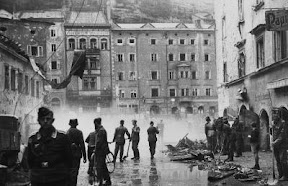
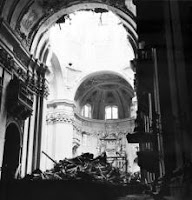
I learned about the air raids over Salzburg in a book that I catched some time ago, an autobiography of playwright Thomas Bernhard, who happened to spend his childhood in Salzburg during WWII.
Fortunately, I have never found myself in a bombing raid, and I do not know how would I act. I think fear would completely paralyse me, but I hope I never know. What I do know is that the only thing that is left is destruction, stillness, emptiness. But we humans do not seem to learn the lesson.
The famous view from the Dresden City Hall Tower comes to my mind. Or the ghostly quietness of the Old Town of Belchite, destroyed by Francoist troops during the Spanish Civil War and kept untouched as a tribute and as a warning.
I hope I'll never know how it feels to walk through the streets of your home town after being destroyed. But I guess it may feel like walking through a forest after a fire. That is an image I for sure will never forget. It was in Vespella, near Tarragona. I had ridden my bicycle to the top of a hill, and at the other side there was nothing but desolated moon landscape for as long as my eyes could reach. Tortured black tree corpses everywhere. Ashes. The smell. The unnatural stillness. Destruction. Absolute emptiness.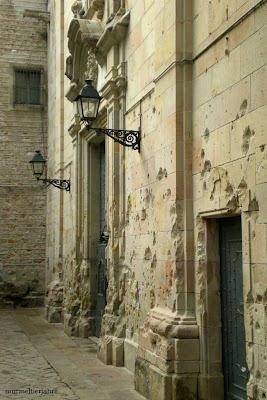

Sunday, 23 December 2007
Driving home for Xmas...
Well, actually we didn't drive, we flew home. But the spirit is the same as in the song, because we started our travel (almost our journey!) yesterday in the morning and we arrived home at night. But it's really nice to meet (again or, in some cases, for the first time in person!) with those who have been supporting me all the time.
I am quite excited about these Xmas! :)
Sunday, 16 December 2007
The Source of All Things
When you decide to move to another country, it has to be clear that there is a lot of things that you are going to miss. Besides your friends and family, of course, most of the things that you are going to end up missing are quite surprising, because they are quite trivial, like fried corn, the music of a jackpot machine in a bar or water-filled ashtrays, and because you realize that you miss them the first time you see them again.
Other things you know you are going to miss from the very beginning. Before moving to Austria I told someone here that one of the things that I was going to miss the most was the sea. He looked at me with a strange look on his face and he told me that I should not worry, because there are lots of lakes here in which one can go swimming in summer. All right. Great. It is not what you can do on the sea what I miss. I miss the sea. Just like that. But they don't get it. Maybe because they are not able to understand it at all.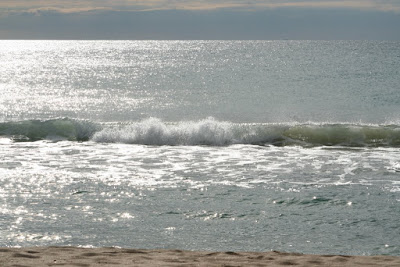
But I am not alone. I know there's someone who understands me. I get understanding from my friend K's blue eyes, where I am able to see the sun reflection on the North Sea over the bow of his Phaleron. I get understanding from the sarcastic smile of a Swedish girl, who asked herself what is really the point of all those Germans who buy themselves a boat to sail around a lake.

But, what is it about the sea? Why do we all who grew at its shores miss it so much? Why do we feel so attracted to the sea?
My mother always told she needs the sea because it is an escape way. Because knowing that the sea is there, she does not feel trapped on solid ground. She might have something there, but I believe there is a deeper reason.
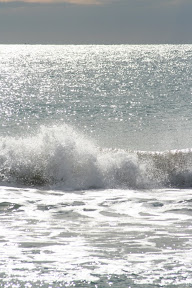
Because the sea is the source of everything. The sea gave us life millions of years ago, and it keeps us alive ever since. It is the sea who gives us our bread. As I look at the sea, I marvel at its incredible beauty, and I could spend hours and hours watching, listening to the waves breaking onto the cliffs, letting the smell of the salt into me, stepping down in respect in front of its infinite power. As I look at the sea I think that everything began just there. And it is still there, after all that happened, and this provides a security and cosiness quite similar to the one you might feel going home. Because I think that the sea is, actually, our home.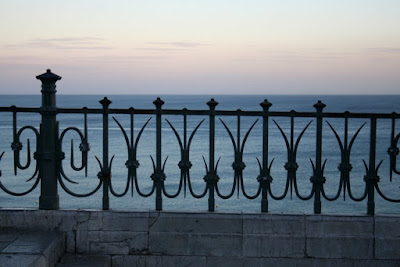
I live far away. But I know it's there, and I just need to close my eyes to see the colours, to hear the waves letting their white hair go before dying on the sand with a murmur.
Subscribe to:
Posts (Atom)
 versión en español


